Large Print Check Register: Free Printable PDF
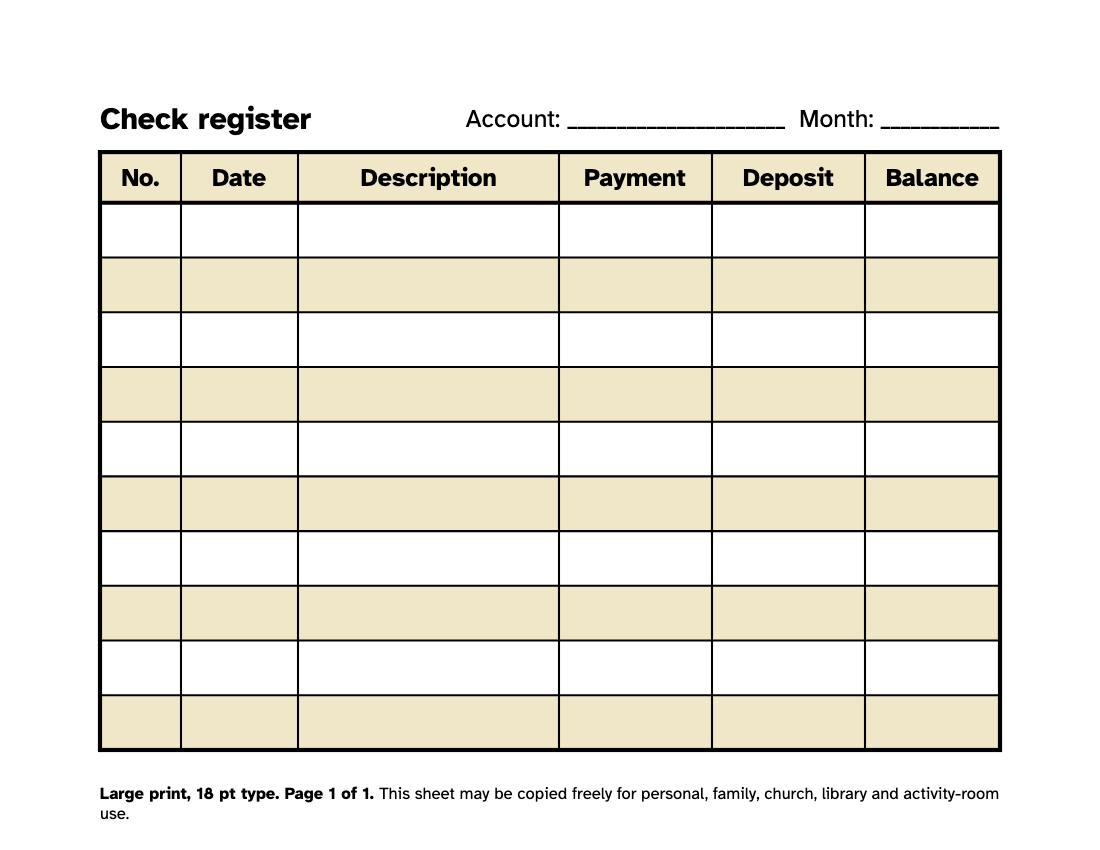
This is a free large print check register with six columns and tall, bold rows: number, date, description, payment, deposit and balance. Choose 1 to 10 pages, an 18, 24 or 28 point type size, and a paper size, then download the PDF and print it.
| Columns | No., Date, Description, Payment, Deposit, Balance |
|---|---|
| Pages per PDF | 1 to 10 |
| Orientation | Landscape, one wide row per entry |
| Type size | 18, 24 or 28 pt |
| Paper | US Letter, A4 or 11 x 17 in |
How do I print a large print check register?
Pick the number of pages, the type size and the paper. Press download. The register prints across the wide side of the paper, with each entry on its own tall row. Every second row has a pale tint, so the eye stays on the same line while moving across to the balance. There is no gray text; the rules are solid black.
How many entries fit on a page depends on the type size and the paper, and the tall rows mean a page holds fewer entries than a bank register does. That is intended. If you write a lot of checks, print several pages at once and staple them, or keep them in a folder with the checkbook. Ten pages is the most a single PDF makes; press the button again for more.
You can add an account name or a month at the top of each page by writing it in by hand. Use a dark pen with a wide tip, since pencil can be faint and hard to read on the tinted rows. Use matte paper if you can, because glossy paper reflects light.
The layout follows the large print guidelines of the American Printing House for the Blind (APH), which set 18 point as the smallest large print size. What large print is gives the full background.
How do you fill in a check register?
Fill in one row for each check, deposit or other withdrawal, at the time you do it, and not later from memory.
| Column | What to write |
|---|---|
| No. | The check number, or a word such as ATM, debit or transfer |
| Date | The day you wrote the check or made the deposit |
| Description | Who you paid, or where the deposit came from |
| Payment | The amount you took out |
| Deposit | The amount you put in |
| Balance | The new total after this row |
To find the new balance, take the balance from the row above, subtract a payment or add a deposit, and write the answer in the balance box. Work slowly and say the numbers aloud if it helps. A large calculator with big keys is worth having next to the checkbook.
Write the date and the amount on your check stub or receipt as well if your bank sends one, so you can look a number up later. Keep the register in the same place as your checkbook, so it is used every time.
How do you balance a checkbook with a large print register?
Balancing means checking your register against the bank statement each month. Take the statement and check off every payment and deposit in your register that also appears on it. Anything not checked off has not yet cleared the bank: a check still in the mail, for example.
Start with the statement balance, add deposits you have made that are not on the statement, and subtract payments you have written that are not on it. The result should match your own balance in the register. If it does not, check the arithmetic on each row, and check that no payment has been counted twice.
Ask someone you trust to check it with you if the numbers are hard to see. Reading the figures aloud to each other is a normal way to do this, and it is worth doing once a month. If a balance never seems to match, ask your bank to explain any entry you do not recognize.
If you keep a household list of what to pay and when, the large print lined paper has wide bold lines for writing it out by hand, and a weekly shopping budget can start from the large print grocery list. For bills that come due each month, the large print bill log records the date paid and the confirmation, and every money sheet is collected under large print money forms.
Can I make it easier to read with low vision?
Yes. Change the type size first: 24 or 28 point makes the printed headings and the row numbers bigger. Choose the cream background if white paper glares. Choose 11 x 17 inch paper for the widest rows, which suits a register kept on a desk rather than in a checkbook cover.
Good light on the page helps as much as bigger type. Put a lamp on the side opposite your writing hand so your hand does not cast a shadow. A ruler or a piece of card laid under the row you are writing in helps you keep to the line.
If you keep your records on paper because a screen is difficult, this register is meant to be as comfortable as a printed one can be. Paste your own text, such as a list of regular bills, into the large print maker and print that as well.