Large Print Bingo Cards: Free Printable PDF, 75-Ball
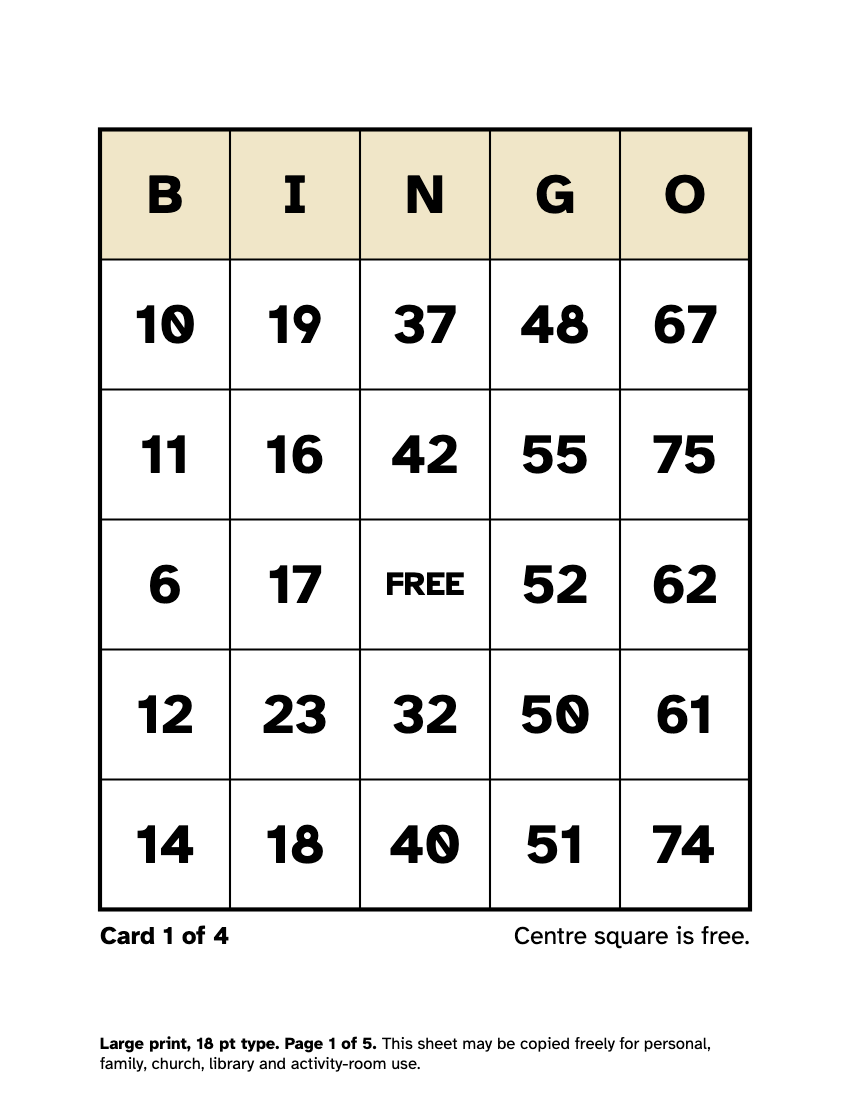
Choose how many cards you need, from 1 to 40, and press download. Each card is a 75-ball bingo card on its own page, with big bold numbers, a free space in the middle and thick black lines. Every download is a new random set. Add a caller list if you need one.
| Game | 75-ball bingo, free center space |
|---|---|
| Cards per PDF | 1 to 40, one card per page |
| Cards | A new random set each time you press download |
| Caller list | Optional page listing all 75 numbers |
| Paper | US Letter, A4 or 11 x 17 in |
How do I print large print bingo cards?
Set the number of cards, check the box for a caller list if you want one, and choose a type size and a paper size. Press download and print the PDF. Each card fills a page, so one sheet of paper is one player's card.
A fresh random set is made every time you press the button. If you print for a whole room, make one PDF with all the cards you need rather than several small ones, so the whole set is printed together.
Print on matte paper, and if the room is bright, choose the cream background to reduce glare. For a group, 11 x 17 inch paper gives the biggest numbers. Slip the cards into plastic sleeves or a clipboard so they can be used with dry-wipe markers or bingo chips. Many players find chips easier than daubers when their hands are not steady.
The numbers are set in bold, far larger than the 18 point body text that the American Printing House for the Blind (APH) sets as the floor for large print, and the lines are pure black. Read what is large print for the reasons behind the design.
What numbers go in each column of a bingo card?
A 75-ball card has five columns headed B, I, N, G and O. Each column draws from its own range of numbers, and the center square of the N column is a free space.
| Column | Numbers |
|---|---|
| B | 1 to 15 |
| I | 16 to 30 |
| N | 31 to 45 (center is free) |
| G | 46 to 60 |
| O | 61 to 75 |
The caller list, when you switch it on, prints all 75 numbers grouped under their letters in the same large type. The caller can mark each number as it is drawn, which also settles arguments about whether a number has been called.
How do you run bingo for people with low vision?
Call each number twice, with its letter, and say the digits separately as well: "B, seven. B seven." A number like 15 is easily mistaken for 50 by ear, so many callers say "one five" after "fifteen".
Keep the pace slow. Leave time to find the number and mark it. Read the numbers already called back on request. If you have a helper, they can walk round the room and check cards for anyone who wants that.
Sit players near the caller and away from windows with glare behind the card. Good light on the card matters more than a bigger card once the type is already large. If players have limited hand movement, use big flat chips or paper squares rather than small counters.
Bingo is one of the easier games to make welcoming, since everyone plays the same game at their own pace. It works well alongside another afternoon activity such as a large print Yahtzee score sheet at a second table, and an activity coordinator can add each session to the large print calendar so residents know when it is. For a card table, the large print rummy score sheet is another easy pick, and every game sheet is listed under large print games.
Can I make 90-ball bingo cards here?
No. These cards are 75-ball cards, the style used across the United States. The 90-ball game played in the United Kingdom and elsewhere uses a different layout with three rows and nine columns, and this page does not make it. If you need 90-ball cards, this is not the page. You can still paste your own text, such as a list of prizes or the house rules, into the large print maker and print it in the same large type.
You may copy the cards freely for personal, family, church, library and activity-room use; the note is printed at the foot of every page.